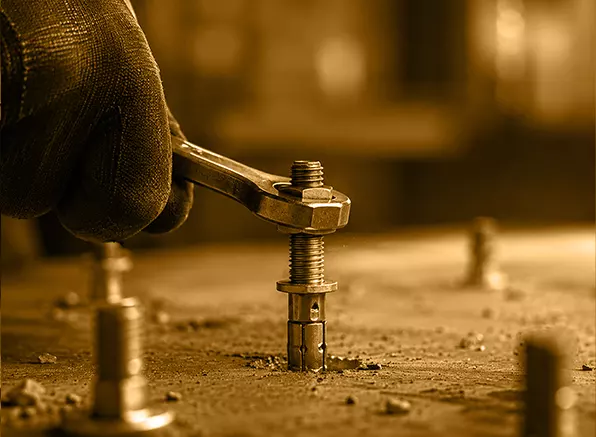
Mechanical Anchor Bolt Installation

کاشت بولت مکانیکی

Mechanical Anchor Installation Services

1

Structural Assessment and Site Preparation

Assessing concrete strength, the installation location, and applied loads.
2

Drilling and Cleaning

Drilling to the required diameter and depth and removing dust.
3

Mechanical Anchor Installation

Installing mechanical anchors, wedge anchors, concrete screws, or undercut anchors.
4

Torque Application and Quality Control

Achieving the design capacity and performing pull-out tests for critical projects.

Mahtecsa: Specialist Mechanical Anchor Installation

In civil engineering, industrial, and building projects, mechanical anchor bolt installation plays a critical role in load transfer and securely connecting equipment to concrete structures. Mahtecsa provides mechanical anchor supply, drilling, and installation services through a skilled team using professional equipment and engineering standards. Technical consultation and a review of site conditions allow mechanical anchor installation costs to be calculated accurately, balancing project cost and quality.

مهتکسا مجری تخصصی کاشت بولت مکانیکی
Latest Projects
Mechanical Anchor Bolt Installation

The combination of hands-on experience, engineering-driven management, and a commitment to quality enables Mahtaksa to deliver projects with precision, predictability, and consistent adherence to standards.

Key Design and Installation Considerations for Mechanical Anchors

Concrete Strength Class

Selecting the anchor and installation method according to the actual concrete strength.

Anchor Spacing

Maintaining appropriate spacing to prevent failure or cracking.

Concrete Edge Distance

Preventing localized stresses and concrete cone failure.

Risk of Concrete Cone Failure

Assessing concrete conditions to maintain load-bearing capacity.

Steel Failure

Verifying that the bolt section will not yield or fracture.

Tensile and Shear Failure

Assessing applied loads and the load-transfer mechanism.

Project Seismic Conditions

Applying seismic criteria for critical projects.

Compliance with International Standards

Following ACI 318 and ETA requirements to ensure safety and quality.

Factors Affecting Mechanical Anchor Installation Costs

FactorINTERPRETATION
Type of bulletWedge, Sleeve, Undercut or Concrete Screw
Bolt diameter and lengthLarger size → more materials and runtime
Number of planting pointsIncreasing numbers, increasing time and cost
Concrete thicknessStrong or thick concrete requires special equipment
Access to the installation siteConstraints complicate implementation.
Need for testing and quality controlSensitive projects require Pull Out Test

Why Choose Mahtecsa for Mechanical Anchor Installation?

  • Specialist Installation to International Standards — All work follows ACI 318 and ETA requirements.
  • Technically Approved Anchors — Supporting structural load capacity and safety.
  • Accurate Drilling with Professional Equipment — Fast, safe work even in high-strength and reinforced concrete.
  • Quality Control and Pull-Out Testing — Pull-out tests for critical projects.
  • Technical Consultation Before Installation — Selecting the anchor and installation method according to actual project conditions.
  • Industrial and Building Project Experience — Successful execution across hundreds of strengthening and industrial projects.
چرا مهتکسا را برای کاشت بولت مکانیکی انتخاب کنید؟
کاشت بولت مکانیکی CTA

Mahtaksa Concrete Structure Repair Services

What We Offer at Fater Sazeh Iranian (Mahtaksa)

Concrete Consulting and Supply

کاشت بولت مکانیکی CTA
Frequently Asked Questions
Need Consultation for Your Structural or Civil Engineering Project

Submit your request, and the technical team at Fater Sazeh Iranian will conduct an initial review of your project and contact you as soon as possible to provide consultation and further details.

فرم مشاوره

What Is a Mechanical Anchor?

A mechanical anchor is a metal anchor secured in concrete through mechanical engagement, without adhesive or resin. Its main advantage is immediate loading after installation, unlike a chemical anchor, which requires resin curing.

Anchor Types and Applications

Anchor typeBenefitsApplications
Wedge AnchorQuick installation, adequate load capacityColumns, plates, industrial equipment
SleeveSuitable for medium loadsFence installation, light and medium-heavy equipment
Concrete ScrewReduces expansion stress, can be opened and closedFacade, temporary equipment
Undercut AnchorHigh capacity, dynamic load performanceSensitive and industrial projects

Wedge anchors, sleeve anchors, concrete screws, and undercut anchors provide reliable solutions for installing equipment and structures in industrial, civil engineering, and building projects. Each type is selected according to project requirements, applied loads, and installation conditions to ensure a durable, safe connection with the required capacity.

Mechanical Anchors Versus Chemical Anchors

PropertyMechanical boltChemical bullet
Operating timeInstantNeed for resin curing
Autoplay SpeedVery highMedium
Resistance to heavy loadsUpperVery high
Dependence on environmental conditionsSlightly[locke] harder!
Instant loading capability.No
Implementation costMore economicalHigher

Both methods connect equipment and steel structures to concrete, but the right choice depends on project conditions, loading, and construction constraints. Immediate loading, fast installation, and no curing delay make mechanical anchors widely used in industrial, building, and service installation projects. Chemical anchors, however, generally perform better where very high capacity, small edge distances, or installation in damaged concrete is required.
 

more

شبکه های اجتماعی

Request a Project Consultation

Name