Steel Jacketing

ژاکت فلزی

Steel Jacketing Installation Steps

1

Structural Inspection and Assessment

Engineers assess the columns, existing damage and strengthening requirements.
2

Design and Construction Drawings

Angle sizes, plate thicknesses, strap spacing and connection details are designed in accordance with FEMA 356 and Iranian Publication 360.
3

Concrete Surface Preparation

Damaged concrete is removed, and sandblasting or bush hammering roughens the surface to improve bonding.
4

Installing Longitudinal Steel Angles

Angles are installed at the four corners of the column to transfer axial and bending forces.
5

Installing Steel Straps and Confinement Plates

Straps installed at specified intervals confine the concrete core and prevent local buckling.
6

Welding Connections

Weld quality is critical and must comply with structural welding standards.
7

Grouting

The gap between the existing concrete and steel jacket is filled with non-shrink mortar to ensure full stress transfer.
8

Corrosion and Fire Protection Coatings

Epoxy and fire protection materials improve durability under environmental exposure.

Steel and Metal Jacketing by Mahtecsa

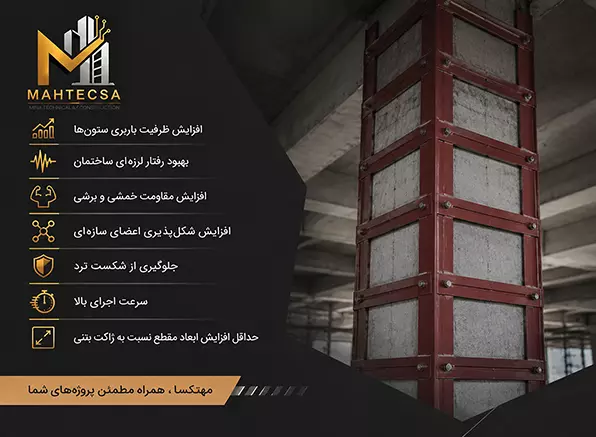
Mahtecsa Civil Engineering and Concrete Repair Company specializes in structural strengthening and seismic rehabilitation, providing the design, calculations and installation of strengthening systems in accordance with current standards and code requirements. One widely used method for increasing the load-bearing capacity of concrete columns is steel jacketing or metal jacket installation. By providing effective confinement, it improves the compressive, flexural and shear strength of structural members. This method is widely used for older buildings, earthquake-damaged structures, changes of use and projects requiring increased structural strength.


اجرای ژاکت فولادی و ژاکت فلزی توسط مهتکسا
Latest Projects
Steel Jacketing

The combination of hands-on experience, engineering-driven management, and a commitment to quality enables Mahtaksa to deliver projects with precision, predictability, and consistent adherence to standards.

Types of Structural Strengthening with Steel Jacketing

Column Jacketing with Angles and Straps

A common method uses corner angles connected by steel straps.

Full-Section Enclosure

Steel plates enclose all faces of the member to provide maximum confinement.

Jacketing Combined with Non-Shrink Grout

Specialty grout integrates the jacket with the existing member and transfers loads between the concrete and steel.

Strengthening Beams and Connections

Steel jacketing is used for beams and joints as well as columns.

Steel Jacketing Costs

The price depends on several factors and is determined after an expert site visit.

Factors affecting costImpact level
Dimensions and number of columnsMany
Thickness of sheets and cornersMany
Amount of steel consumedMany
Required grout volumeMedium
Project access conditionsMany
Building HeightMedium
The complexity of connections and weldingMany
Anti-corrosion coatingMedium
Fireproof coatingMedium
Need to install bolts and anchorsMedium

For an accurate estimate, Mahtecsa’s specialists inspect the project and review structural drawings before providing the final cost.

Benefits of Steel Jacketing by Mahtecsa

  • Increased column load-bearing capacity
  • Improved seismic performance
  • Increased flexural and shear strength
  • Improved structural ductility
  • Prevention of brittle failure
  • Fast installation
  • Less increase in section size than concrete jacketing
  • Suitable for occupied buildings
  • Lower costs than full reconstruction
  • Improved earthquake safety
مزایای استفاده از ژاکت فلزی در مقاوم سازی با مهتکسا
اجـــرای ژاکــت فلـــزی cta

Mahtaksa Concrete Structure Repair Services

What We Offer at Fater Sazeh Iranian (Mahtaksa)

Concrete Consulting and Supply

اجـــرای ژاکــت فلـــزی cta
Frequently Asked Questions
Need Consultation for Your Structural or Civil Engineering Project

Submit your request, and the technical team at Fater Sazeh Iranian will conduct an initial review of your project and contact you as soon as possible to provide consultation and further details.

فرم مشاوره

How Does Steel Jacketing Increase Structural Strength?

This system works by confining the concrete core. Steel angles and plates resist part of the compressive and bending forces, while transverse straps increase member shear strength. The main results include:

  • Increased column axial strength
  • Increased structural member flexural capacity
  • Prevention of brittle shear failure
  • Increased structural ductility
  • Prevention of longitudinal reinforcement buckling
  • Increased earthquake energy absorption
  • Improved building performance under seismic loads

Components of a Metal Jacketing Strengthening System

This method comprises several main components, each playing an important role in increasing load-bearing capacity and improving seismic performance.

  • Longitudinal Angles

Angles are placed at the four corners of the column to transfer axial and bending forces. Their dimensions and thickness are determined by structural calculations.

  • Confinement Straps and Plates

Steel straps are connected to the angles at specified intervals to confine the concrete core. In addition to increasing shear strength, they prevent local buckling of longitudinal members.

  • Non-Shrink Grout

Voids between existing concrete and steel components are filled with cementitious mortars or specialist resins to ensure uniform stress transfer between steel and concrete.

  • Bolts and Mechanical Anchor Bolts

Some installation details use post-installed rebar and bolts to provide suitable connections and force transfer between existing concrete and new components.

  • Corrosion Protection Coating

Because steel is susceptible to environmental exposure and moisture, epoxy paints and protective coatings improve durability and prevent rusting.

  • Fire Protection Coating

Fire-resistant coatings are essential in many projects to improve fire resistance and maintain the load-bearing capacity of steel members.

Steel Jacketing Design Rules and Code Requirements

Design and installation must comply with recognized national and international codes to ensure suitable structural performance during service and earthquakes.

  • FEMA 356 Guidelines: A key reference for building seismic rehabilitation, providing criteria for increasing structural member strength and ductility.
  • Publication 360 of the Plan and Budget Organization: Publication 360 is the main reference for seismic rehabilitation of existing buildings in Iran, explaining design and installation requirements for various strengthening methods.
  • ACI 318: This standard provides requirements for reinforced concrete member design and behavior, strength checks and construction details.
  • National Building Regulations: Chapter 9 and other National Building Regulations must also be considered in strengthening project design and execution.

The main design checks include:

  • Local buckling of longitudinal angles
  • Appropriate spacing of confinement straps and plates
  • Shear transfer at the column base
  • Suitable foundation connection design
  • Beam-column connection details
  • Foundation load-bearing capacity
  • Structural seismic performance after strengthening
  • Welding and connection quality
more

شبکه های اجتماعی

Request a Project Consultation

Name